SCCT for Reddit: How Crisis Communication Theory Applies to Community Platforms
Situational Crisis Communication Theory (SCCT) was built for traditional media. Here's how to adapt it for Reddit's community-driven dynamics.
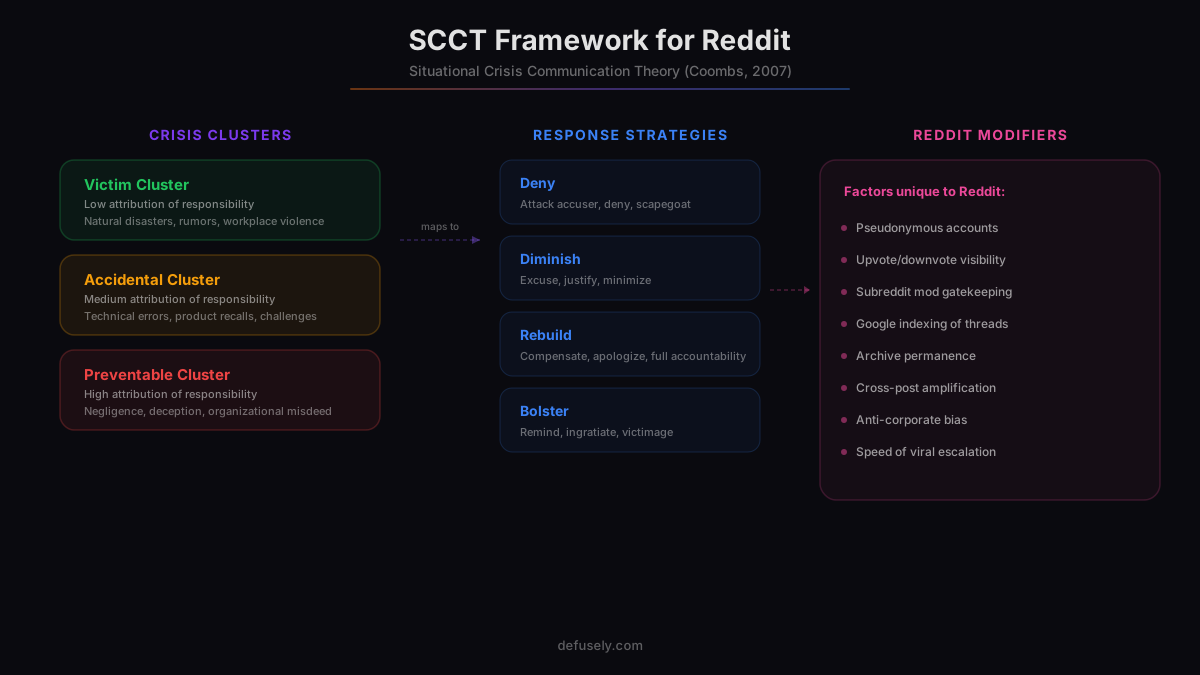
How does SCCT apply to Reddit? Situational Crisis Communication Theory (SCCT) classifies crises into three clusters — victim, accidental, preventable — each mapping to a recommended response strategy. The core framework holds on Reddit: audience attribution of responsibility determines how they receive your response. Four adaptations are required: (1) attribution happens publicly in the comment section within hours, not through media coverage over days; (2) diminish strategies only work with verifiable evidence; (3) corrective action outweighs apology on Reddit; (4) crisis history is permanently visible through cross-linked threads.
Situational Crisis Communication Theory (SCCT) is the most widely used framework in crisis communication. Developed by W. Timothy Coombs in 2007, it gives organizations a systematic way to match their response strategy to the type of crisis they’re facing.1
The framework was built for a world of press conferences, media statements, and journalist relationships. It works. The research is strong. The logic is sound.
But Reddit isn’t that world. And applying SCCT without adapting it to Reddit’s mechanics leads to responses that are technically correct and practically ineffective.
SCCT in 60 seconds
Coombs’ framework classifies crises into three clusters based on how much responsibility the audience attributes to the organization.
Victim cluster. The organization is perceived as a victim of the crisis (natural disaster, product tampering, rumor). Attribution of responsibility is low.
Accidental cluster. The crisis was unintentional (technical failure, product defect based on good-faith decisions). Attribution is moderate.
Preventable cluster. The organization knowingly took actions that caused the crisis (negligence, deception, violation of regulations). Attribution is high.
Each cluster maps to a recommended response strategy. Victim crises call for instructing information and sympathy. Accidental crises call for excuse or justification alongside corrective action. Preventable crises demand full apology and corrective action.
What SCCT gets right about Reddit
The core insight holds perfectly: the audience’s attribution of responsibility determines how they receive your response.
Reddit communities are, if anything, more attuned to attribution than general media audiences. Redditors actively investigate causation. They post evidence. They link to previous incidents. They distinguish between “this company got unlucky” and “this company knew and didn’t act.”
SCCT’s principle that response strategy should match attribution level is exactly right for Reddit. Where the adaptation is needed is in execution.
Defusely applies SCCT crisis cluster classification to every War Room. AI recommends the response strategy based on crisis type — victim, accidental, or preventable — then generates Reddit-native drafts calibrated to the framework. Your team confirms the strategy and refines the tone. See how it works →
Four ways Reddit changes the application
1. Attribution happens in public, in real time. In traditional crisis communication, attribution forms through media coverage over days. On Reddit, attribution happens in the comment section within hours. Community members investigate, share evidence, and reach consensus before most organizations have issued their first statement. Your classification must match the community’s evidence base, not just your internal assessment. If the community has posted evidence that the crisis was preventable and you respond with a victim-cluster strategy, the mismatch destroys credibility instantly.
2. The “diminish” strategies have a shorter shelf life. SCCT includes diminish strategies for accidental crises: excuse and justification. On Reddit, diminish strategies get stress-tested immediately. “We had limited control over this” gets met with “Then why did your own documentation say…” followed by a link to your public-facing docs. Diminish strategies only work on Reddit if they’re backed by specific, verifiable evidence.
3. Corrective action carries more weight than apology. SCCT positions full apology as the strongest response for preventable crises. On Reddit, apology alone is often insufficient. “We’re deeply sorry” without corrective action reads as performative. Reddit audiences have seen too many corporate apologies that led to nothing. The credibility currency is action, not words. Lead with corrective action, follow with apology. Reverse the traditional SCCT sequence for preventable crises on Reddit.
4. Crisis history is permanently visible. SCCT identifies crisis history as an intensifying factor. On Reddit, crisis history isn’t just an intensifying factor — it’s primary evidence. Reddit users link to previous threads. They build timelines. They maintain community memory in sidebar links and wiki pages. A second crisis of the same type is a documented pattern that makes your response exponentially harder.
Your severity model must account for Reddit-specific crisis history. Defusely tracks brand mention history across subreddits so your team knows what the community remembers before choosing a response strategy. Start my free 7-day trial →
Applying the adapted framework
When a Reddit crisis hits, run this sequence:
Step 1: Read the thread and community evidence. Before classifying, understand what the community knows and what evidence they’ve surfaced.
Step 2: Classify using SCCT clusters, matched to community evidence. If the community has evidence of preventability, don’t classify it as accidental internally.
Step 3: Check for intensifying factors on Reddit. Search for previous threads about your brand in related subreddits. Are previous incidents being linked in the current thread?
Step 4: Select strategy, adapted for Reddit norms. For victim crises: instructing information plus transparency. For accidental crises: corrective action plus evidence supporting accidental classification. For preventable crises: corrective action first, then accountable apology, with specific timelines.
Step 5: Draft in Reddit register. Human voice, specific references to the thread, direct language. Apply the strategy through the communication norms the platform demands.
Step 6: Follow up. SCCT addresses the initial response. Reddit demands follow-through. If you committed to a fix, post the update in the same thread. The community will check.
The research still applies
SCCT is the best framework available for crisis response strategy selection. The research base is strong. The logic is validated across hundreds of cases.2
The gap isn’t in the theory. It’s in the execution layer between “this is a preventable crisis that requires corrective action and full apology” and the actual Reddit comment that implements that strategy.
That execution layer requires Reddit-specific infrastructure: severity scoring that accounts for the platform’s mechanics, response drafting that matches the community’s register, and approval workflows that move at the speed the platform demands.
The theory tells you what to do. The infrastructure helps you do it before the thread peaks.
SCCT-backed crisis strategy, executed at Reddit speed. Defusely classifies every incident by crisis cluster, recommends the response strategy, and generates Reddit-native drafts calibrated to the framework — all within a structured War Room. Start my free 7-day trial →
Footnotes
Footnotes
- [1] Coombs, W.T. (2007). "Protecting Organization Reputations During a Crisis." Corporate Reputation Review, 10(3), 163-176.
- [2] Coombs, W.T. (2015). "The value of communication during a crisis: Insights from strategic communication research." Business Horizons, 58(2), 141-148.
- [3] Benoit, W.L. (1997). "Image Repair Discourse and Crisis Communication." Public Relations Review, 23(2), 177-186.
Related Articles
Want to see it in action?
Start a free trial and run your next high-risk Reddit thread through a structured War Room.