How to Measure Speed to Recovery in a Reddit Crisis
Most teams can't answer 'how fast did we recover?' after a Reddit incident. Here are the metrics that measure response effectiveness and recovery speed.
How do you measure speed to recovery in a Reddit crisis? Five metrics: (1) Time to Detection (TTD): under 30 minutes is benchmark, (2) Time to First Internal Action (TTFIA): under 15 minutes, (3) Time to First Response (TTFR): under 2 hours for severity 3+, the single most important metric, (4) Time to Sentiment Shift (TTSS): 2-4 hours post-response for severity 3, (5) Time to Resolution (TTR): 24-72 hours for severity 2-3. Track these across incidents to build baselines, identify bottlenecks, and justify infrastructure investment.
After a Reddit crisis resolves, your executive team will ask two questions: “What happened?” and “How fast did we recover?”
Most teams can answer the first question. Few can answer the second with data.
“Recovery” is vague. “Fast” is relative. Without defined metrics, the answer becomes a narrative. Narratives are useful. They’re not measurements.
Why measurement matters
Improvement requires a baseline. If your team responded to a Reddit crisis in March and another in June, you need metrics to know whether you got faster. Without measurement, “we’re getting better” is a feeling, not a fact.
Infrastructure investment needs justification. Crisis response tools, training programs, and dedicated personnel represent real budget. “We reduced average response time from 4 hours to 45 minutes” is a number a CFO can evaluate.
Pattern recognition. Metrics across multiple incidents reveal patterns that individual reviews miss. Maybe your team responds faster to product crises than to executive conduct crises. Patterns only emerge from data.
The five metrics that matter
1. Time to detection (TTD)
The elapsed time between the thread being posted and your team becoming aware.
Benchmark: Under 30 minutes for threads that cross your severity threshold. Under 15 minutes is strong.
What affects it: Monitoring tool alert configuration, alert routing, and whether someone is watching during off-hours.
2. Time to first internal action (TTFIA)
The elapsed time between awareness and the first structured action: severity assessment, owner assignment, or War Room creation.
This metric measures the gap between “we know about it” and “we’re working on it.” In organizations without structured workflows, this gap can be hours.
Benchmark: Under 15 minutes. Under 5 minutes is strong.
Defusely compresses TTFIA to under 3 minutes. Alert triggers a War Room automatically. Thread ingested, severity scored, owner assigned. Your team skips the “who’s handling this?” phase entirely. See how it works →
3. Time to first response (TTFR)
The elapsed time between the thread being posted and the organization’s response appearing in the thread.
This is the metric executives care about most. On Reddit, the response window is finite. Responses posted within the first 4-8 hours are significantly more effective than responses posted after the thread has crested.1
TTFR captures the full pipeline: detection, assessment, decision, drafting, approval, and posting.
Benchmark: Under 2 hours for severity 3+. Under 4 hours is acceptable. Over 8 hours means you missed the window.
What affects it: Everything. When TTFR is too high, trace the pipeline to find the bottleneck.
4. Time to sentiment shift (TTSS)
The elapsed time between posting the response and observing a measurable change in the thread’s sentiment trajectory.
This is the recovery metric. TTFR tells you how fast you responded. TTSS tells you whether it worked.
Measure through: upvote trajectory on the brand response, ratio of constructive vs. hostile replies, overall thread velocity change, and cross-posting activity.
Benchmark: Severity 3: positive shift within 2-4 hours. Severity 4-5: shift within 8-12 hours may be the best achievable outcome.
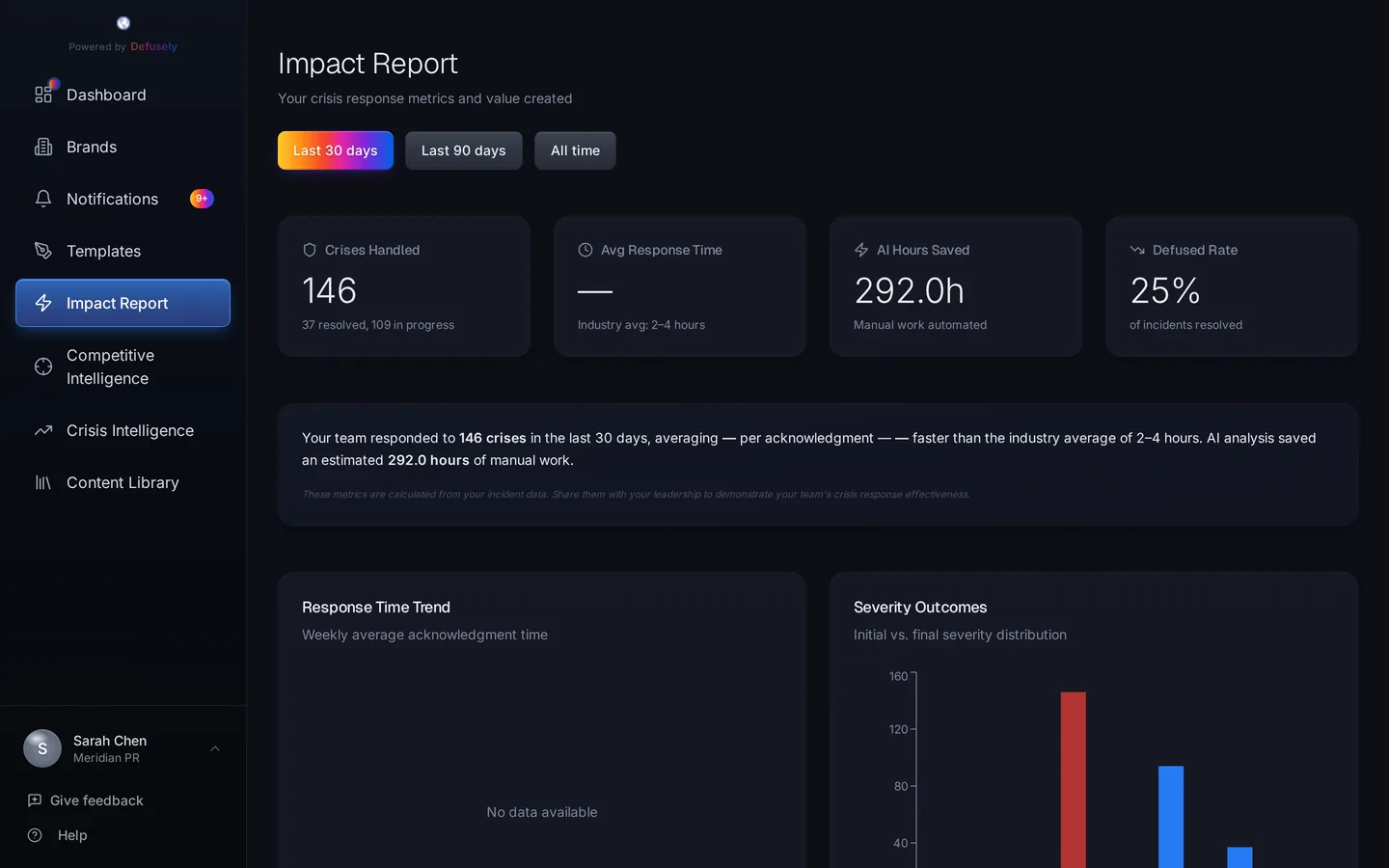
Track every metric automatically. Defusely timestamps detection, severity scoring, owner assignment, drafting, approval, and posting. Your post-mortem metrics are pre-calculated. No manual tracking required. Start my free 7-day trial →
5. Time to resolution (TTR)
The elapsed time between the thread being posted and the incident being marked as resolved. Resolution means: active engagement has subsided, corrective action is taken, and a post-mortem is conducted.
Benchmark: Severity 2-3: 24-72 hours. Severity 4: 3-7 days. Severity 5: 1-4 weeks.
Secondary metrics worth tracking
Approval chain duration. Time from draft submission to final approval. If this consistently exceeds 30 minutes for severity 3+, your approval process is a bottleneck.
Escalation accuracy. How often the initial severity assessment matched the incident’s actual trajectory. Track the delta between initial and final severity scores.
Response reception score. Net upvote count on the brand’s response, normalized by subreddit size. Track this to calibrate response quality over time.
Building a measurement practice
Capture timestamps automatically. Every action in the crisis workflow should be timestamped by the system, not by someone remembering during a high-pressure incident.
Calculate metrics in the post-mortem. The post-mortem template should include a metrics section where all five primary metrics are calculated from timestamp data.
Track across incidents. Maintain a running dashboard that plots metrics across every Tier 3+ incident. Trends become visible after 5-10 incidents.
Set targets, then beat them. Once you have baseline data from 3-5 incidents, set target metrics. “Reduce average TTFR from 3.5 hours to 2 hours.” Targets focus improvement on the bottlenecks that matter most.
The metric that matters most
If you’re going to track one number, track TTFR. Time to first response captures the full pipeline and is the strongest predictor of crisis outcome.
A team that consistently responds within 2 hours is operating at a fundamentally different level than a team that responds in 6. The thread state at hour 2 and hour 6 are different threads. The audience composition is different. The narrative is either still forming or already solidified.
Everything in your crisis infrastructure should bend toward reducing TTFR: faster detection, faster assessment, faster decision-making, faster drafting, faster approvals. Each minute matters, and the metrics prove it.
Every action timestamped. Every metric pre-calculated. Defusely tracks TTD, TTFIA, TTFR, TTSS, and TTR automatically across every War Room. Your post-mortem data is captured as a byproduct of the response workflow. Start my free 7-day trial →
Footnotes
-
Reddit thread visibility mechanics: high-engagement threads peak within 4-8 hours of posting. ↩
Footnotes
Related Articles
Want to see it in action?
Start a free trial and run your next high-risk Reddit thread through a structured War Room.